PANAMA SERIES
The Late Tropics
The Late Tropics is my term for a moment in the anthroposcene, a time when we find ourselves pondering the dire ecological present tense while simultaneously listening to a past. The Late Tropics is also about the Isthmus of Panama as a literal and figurative palimpsest, it’s accumulated iterations, progression of waters, lands, animals and plants near the equator. The waning American military presence in the Republic of Panama created opportunities for conservation groups who wanted to stake a claim in the preservation of the ecologically diverse Panama Canal Watershed. The water running through its locks acts as prescient global funnel, forcing the ecology of the Canal Zone through a progressively narrowing space; the land and it specificity is giving way to the genericized pressure for the movement of goods. In this scene is the metaphor of both the obvious mutation of the region under the weight of globalism and as a description of the loss of local sovereignty. My research in Panama is undertaken on former military lands now under the conservation stewardship of local NGO’s such as the Asociación Panamericana para la Conservación.
Soundscape for the BioMuseo - exhibition view
Designed by architect Frank Gehry, the BioMuseo features eight gallery-style exhibits designed by Bruce Mau.
The water running through its locks acts as prescient global funnel, forcing the ecology of the Canal Zone through a progressively narrowing space; the land and it specificity is giving way to the genericized pressure for the movement of goods. In this scene is the metaphor of both the obvious mutation of the region under the weight of globalism and as a description of the loss of local sovereignty.
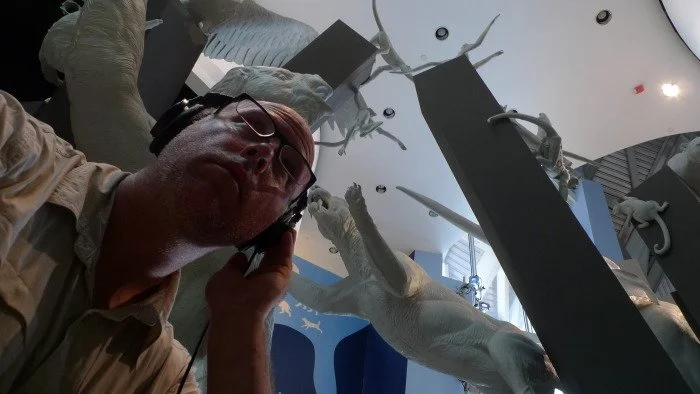
The Artist in the Biomuseo, in the manner of Peale.
The animal forms inside stride along a fictional isthmus and an actual casuseway, the build site for the Biomuseo. From inside the museum’s walls one can watch the present become the past with a sense of the abstracted global pressures that lay beyond. The soundscape will remain intact, in a form of hermetic trust, a composed day cycle that is it’s now a part of a contemporary display about natural history.
For me, this BioMuseo is an experiential parable about uncertainty and eminent change. It comes from a palpable cultural friction produced by the oppositional relations of conservation and economic expansion in the Panama Canal Zone. The Canal is the hourglass of the Americas, a fluid focal point that contains both direct consequences for the people of Panama and the natural world.

The Artist in His Museum - Charles Wilson Peale 1822.